

TL;DR
- Static masking replaces sensitive data permanently in non-production copies
- Dynamic masking filters query results by role without changing storage
- Both leave cleartext on disk — compliance scope stays unchanged
- Tokenization vaults the original and removes it from your systems
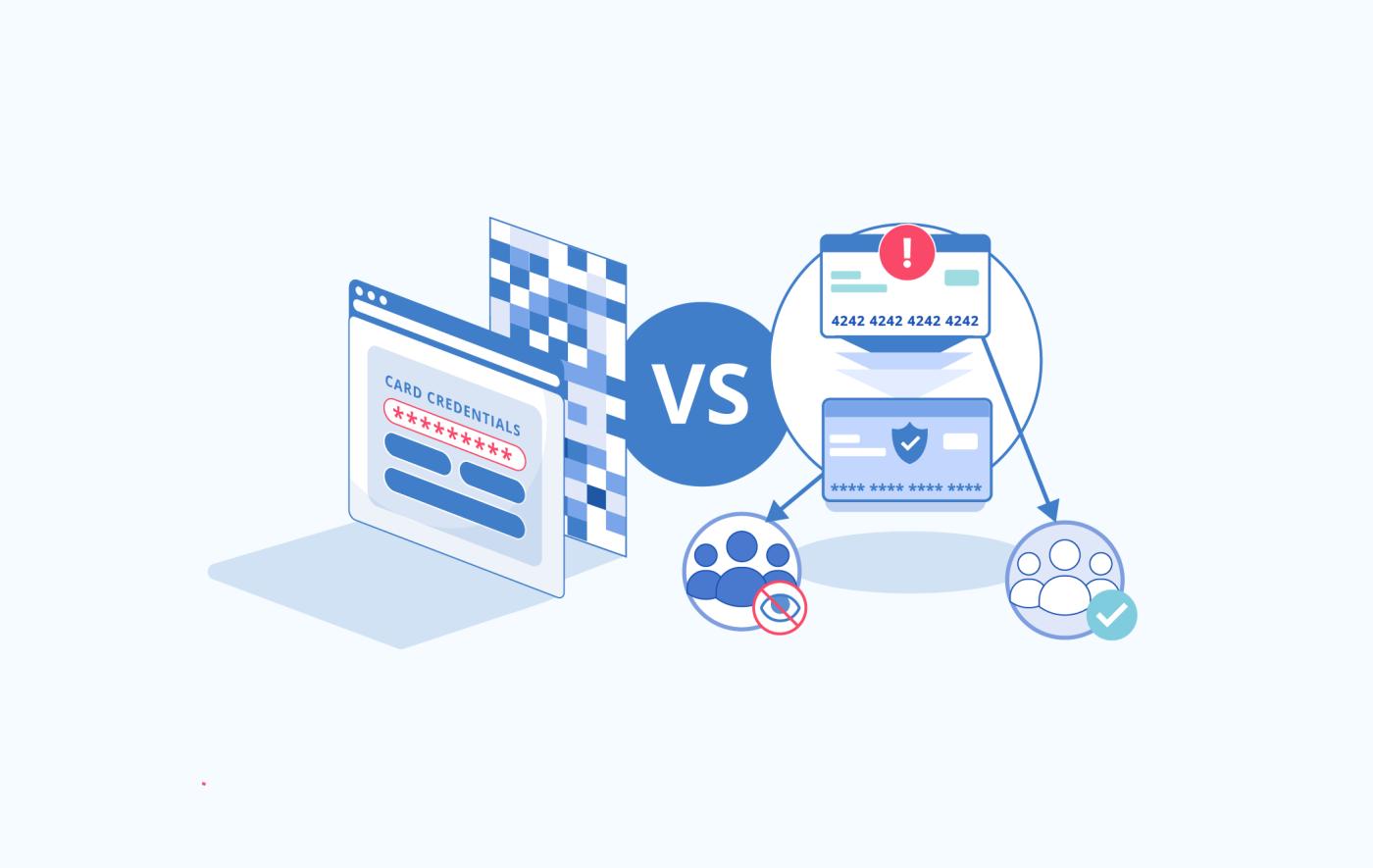
Data masking replaces sensitive values with fictitious substitutes to protect information from unauthorized access. Static data masking permanently alters a copy of your database for use in non-production environments, such as dev/test.
Dynamic data masking masks data in real-time at query time, leaving the original data unchanged on disk. Both are established data protection techniques — and both leave critical gaps. Static masking cannot protect production data.
Dynamic masking can be bypassed, introduces write-back risk, and does not reduce compliance scope. A third approach — tokenization — removes sensitive data from the system entirely, replacing values with non-sensitive tokens stored in a secure vault.
The right strategy depends on where your data lives and what you need to protect.
What Is Static Data Masking?
Static data masking (SDM) extracts and transforms a copy — often a targeted subset or "gold copy" — of your production database, permanently replacing sensitive values with realistic substitutes. The transformation is irreversible.
Once the masked copy is created, there is no mathematical or procedural path back to the original data. This is why SDM is the foundation of test data management (TDM) in regulated enterprises.
How Static Data Masking Works
Common data masking techniques include substitution (replacing "John Smith" with "Jane Doe"), shuffling (reordering values within a column so real values exist but are detached from the correct records), and number variance (shifting dates or amounts by random offsets).
These data masking methods produce realistic data masking examples: an SSN of 123-45-6789 becomes 045-12-3345. A birthdate shifts by a random number of days.
The masked data looks and behaves like production data — but contains none of the sensitive information. SDM is often integrated into ETL (extract, transform, load) pipelines as a transformation step before data reaches non-production environments.
SDM preserves referential integrity across tables. If "John Smith" becomes "Jane Doe" in the customers table, the same transformation applies in the orders and billing tables.
This consistency is essential for realistic test data, but it must be paired with strong access controls — consistent masking patterns can, in theory, enable re-identification attacks if the masked dataset is combined with external data.
Static masking differs from data anonymization, which permanently destroys the link to the original identity without preserving data utility for testing. It also differs from data obfuscation, a broader category that encompasses methods for hiding data, including encryption, hashing, and masking.
Unlike synthetic data generation, which creates artificial datasets from scratch, static masking preserves the nuances and edge cases of real production data — the kind of complexity that catches defects earlier in the development cycle.
What Is Dynamic Data Masking?
Dynamic data masking (DDM) operates on a fundamentally different principle. Instead of creating a masked copy, DDM intercepts queries in real-time and applies masking rules at the presentation layer. The original sensitive data remains unchanged in the database.
Authorized users — typically those with elevated role-based access control (RBAC) privileges — see the real data. Unauthorized users see masked values.
This distinction from encryption at rest is important: DDM does not cryptographically transform the stored data. It intercepts and modifies the query results before they reach the user's screen.
How Dynamic Data Masking Works
DDM can be implemented through a database proxy that sits between users and the database, or through native database features like SQL Server dynamic data masking or Snowflake dynamic masking. In a proxy-based model, every SQL query passes through the proxy, which inspects the requesting user's role and modifies the result set accordingly.
A query requesting SSNs returns XXX-XX-3099 instead of 147-22-3099 for unauthorized users. PII data masking for call centre agents, analysts accessing sanitized reports, and customer service representatives viewing redacted PHI are the primary use cases.
Some databases also offer native alternatives such as row-level and column-level security, though these lack the flexibility of full DDM implementations.
Limitations of Dynamic Data Masking
DDM has five structural weaknesses that enterprise security teams must evaluate.
Write-back risk. In read/write environments, masked values can be written back to the database, corrupting the underlying data. This is why DDM is recommended only for read-only reporting and data discovery scenarios.
Proxy bypass. If DDM is implemented via a proxy, users who connect directly to the database bypass the masking layer entirely. The original sensitive data is fully exposed to anyone with a direct connection.
Inference attacks. Even without seeing unmasked values, users can construct filter queries to deduce sensitive data through the process of elimination.
A query like SELECT name FROM employees WHERE salary BETWEEN 95000 AND 105000 can reveal individual salaries without the masking layer ever being triggered. This risk applies to both proxy-based and native DDM implementations.
Privileged user bypass. Database administrators typically have permissions that override DDM rules. DDM protects application-layer users but offers no protection against compromised admin credentials — a significant gap given that insider threats and credential theft account for a large share of enterprise data breaches.
DDM does not reduce compliance scope. This is the most dangerous misconception about dynamic masking. Because the cleartext data still resides on disk, the database remains fully in scope for PCI DSS and other compliance audits.
DDM is a privacy control, not a de-scoping control. Perforce's own data masking experts acknowledge this: 76% of organizations use dynamic masking, but it cannot protect sensitive data from compromise in a breach — only static masking or tokenization can do that.
Static vs Dynamic Data Masking: Key Differences
The core distinction is that static masking transforms the data itself, whereas dynamic masking transforms the view of the data.
Both are valid data masking methods, alongside other data obfuscation techniques such as data anonymization and synthetic data generation — but they solve different problems and carry different risk profiles. Most data masking tools implement one or both approaches.
Neither approach fully solves the production data protection problem.
Static masking cannot touch your live production database — it only protects copies. Dynamic masking leaves the sensitive data intact on disk, meaning a breach of the database exposes everything. Your compliance auditors know this. Your data security platform must account for it.
When to Use Each Approach
Use Cases for Static Data Masking
Static data masking is the standard choice for DevOps test data provisioning with realistic yet safe datasets; analytics and BI with de-identified data; third-party data sharing for outsourced development or vendor testing; and cloud migration — masking data on-premises before uploading it to the cloud reduces risk for organizations concerned about cloud-based disclosure.
Training environments that need production-like data without the liability are another common use case.
Use Cases for Dynamic Data Masking
Dynamic data masking fits read-only production scenarios: call centre agents who need partial customer data views, reporting dashboards with role-based field redaction, legacy applications that lack built-in RBAC, and temporary access grants for auditors or contractors.
If your data masking requirement is "control who sees what on screen," DDM data masking tools are the right data masking technique for that specific job.
When Both Fall Short
The gap is in production data protection. Static masking cannot protect your live database — it only produces safe copies. Dynamic masking can be bypassed, introduces inference attack vectors, and does not reduce your compliance scope.
Neither approach addresses shadow data — the untracked copies of sensitive information that accumulate across cloud, SaaS, and analytics environments.
And neither works cleanly across mainframe and legacy systems without heavy infrastructure investment. The distinction between compliance-driven masking (protecting production data to satisfy regulators) and testing-driven masking (creating safe copies for dev teams) matters here.
For testing, static masking is proven and effective. For compliance-grade production protection, both approaches fall short.
What About Tokenization? The Approach Most Teams Overlook
This is where the static-vs-dynamic masking comparison breaks down.
Both approaches assume the sensitive data must exist somewhere in the system — either in the production database (dynamic) or in a copy of it (static).
Tokenization challenges that assumption entirely.
How Tokenization Differs from Both Static and Dynamic Masking
Tokenization replaces sensitive values with non-sensitive tokens and stores the originals in a secure vault. Unlike static data masking, tokenization can protect production data.
Unlike dynamic data masking, the sensitive data is physically removed from the system — not hidden at the presentation layer. Data masking vs tokenization comes down to this: masking disguises data; tokenization removes it.
Data masking vs data redaction is a related distinction.
Redaction permanently blacks out data — like redacted government documents — removing it entirely without a usable substitute.
Tokenization is more flexible because tokens preserve the format of the original value. A tokenized credit card number still passes Luhn checks.
A tokenized SSN still has the right number of digits. Downstream systems, business rules, and validators continue to function.
Format-preserving encryption (FPE), standardized under NIST SP 800-38G as the FF3-1 algorithm, achieves similar format preservation but uses a cryptographic key.
FPE is reversible by anyone with that key. Vaulted tokenization generates a random substitute with no mathematical relationship to the original — even a brute-force attack on a token database yields nothing without vault access.
FPE also carries a "small domain" weakness: short values, such as 3-digit CVV codes, have insufficient domain size for strong encryption, making vaulted tokenization the safer choice for these fields.
When Tokenization Outperforms Both Static and Dynamic Masking
PCI DSS scope reduction is the headline.
When you tokenize cardholder data, the systems handling those tokens are removed from the Cardholder Data Environment (CDE). DDM does not provide this benefit because cleartext remains on disk.
One DataStealth client — a loyalty provider — reduced PCI audit time by 50% through tokenization-based scope reduction.
Breach resilience follows directly.
Even if an attacker exfiltrates your entire database, the tokens are valueless without access to the vault. In a vaulted architecture, sensitive values are fragmented, independently encrypted, and distributed across separate storage locations.
Reconstituting the original value requires broker authorization under strict access controls — even a breach of the vault storage itself yields only encrypted fragments. This is what data-centric security means in practice: the data protects itself.
Agentless deployment matters for mainframe security.
Agentless solutions deploy via a DNS routing change at the network layer, intercepting data flows using native protocols like TN3270 for mainframe terminal access and DB2 for database traffic. No software agents are installed on the mainframe, eliminating the risk of destabilizing decades-old applications that other vendors simply cannot touch.
Data sovereignty closes the case for cross-border enterprises.
Tokenization enables you to keep sensitive values vaulted in the originating jurisdiction — the EU, for example — while sending tokens to teams in other regions.
DDM cannot satisfy this requirement because the cleartext remains physically located in the source database, regardless of where the query originates. For organizations navigating data residency requirements, this distinction makes tokenization the only viable data-masking method for cross-border workflows.
Some platforms combine both approaches.
Dynamic masking can handle real-time terminal access — protecting data on screen — while tokenization handles data at rest and in transit, removing it from the system entirely.
This dual-control architecture means enterprises do not have to choose one approach over the other. Each is applied where it is most effective.
Which Approach Does Each Compliance Framework Require?
The compliance implications of each approach differ more than most teams realize.
The $4.88 million average cost of a data breach in 2024 makes the choice consequential. PCI DSS non-compliance fines alone can run $5,000–$100,000 per month from payment brands.
PCI DSS Requirement 3 mandates rendering cardholder data unreadable wherever it is stored. Static masking satisfies this for non-production copies.
Tokenization goes further by removing cardholder data from the CDE entirely, collapsing audit scope to a small, well-defined zone.
GDPR Article 5 requires data minimization and Recital 26 supports pseudonymization.
Both masking and tokenization qualify, but tokenization is stronger because the sensitive data is physically separated from the processing environment — a critical distinction for data breach resilience under GDPR's mandatory 72-hour notification requirement.
How to Choose the Right Data Protection Approach
Data masking best practices start with matching the approach to the data flow.
If you need safe data for dev/test environments, static data masking is the proven choice. Produce realistic, referentially intact copies for your development teams without exposing sensitive data.
If you need role-based access control on production data for read-only use cases — reporting, customer service, auditor access — dynamic data masking adds a presentation-layer filter without changing the underlying data. Understand its limits: inference attacks, DBA bypass, and no compliance scope reduction.
If you need to protect production data, reduce the compliance scope, and ensure resilience to breaches, tokenization removes sensitive data from the system entirely. This is the approach that changes audit outcomes, not just access patterns.
If you operate across mainframe, cloud, and hybrid environments, agentless data security platforms that combine DDM and tokenization provide consistent protection without per-system agents or code changes. Most enterprises need more than one approach.
The question is not "which one" but "which combination and where."
Protect Your Data Where Masking Falls Short
Most enterprises discover that masking alone — whether static or dynamic — leaves gaps in production data protection and compliance coverage. The answer is deploying each approach where it is most effective.
DataStealth's agentless platform combines dynamic data masking and vaulted tokenization in a single deployment:
- Production data protection: Vaulted tokenization removes sensitive values from your systems entirely — tokens are worthless to attackers without vault access.
- Mainframe and legacy coverage: Deploys via DNS change using native TN3270 and DB2 protocols. No agents, no code changes, no risk of destabilization.
- PCI scope reduction: Clients have reduced PCI audit time by 50% by removing cardholder data from the CDE.
- Role-based terminal access: Dynamic masking for real-time screen-level protection, integrated with Active Directory for policy enforcement.
Book a 15-minute architecture session →
Frequently Asked Questions: Dynamic Data Masking
What is the main difference between static and dynamic data masking?
Static data masking permanently alters a copy of a database before use, while dynamic data masking applies masking rules in real-time at query time without changing the underlying data. Static is for non-production environments like dev/test and analytics. Dynamic is for production read-only access control in scenarios like reporting and call centres.
Is static data masking reversible?
No. Static data masking permanently replaces sensitive values with fictitious substitutes. There is no mathematical or procedural path back to the original data. This irreversibility is why it is considered safer for test data distribution but unsuitable for production databases, where original values must be retained.
Does dynamic data masking change the original data?
No. Dynamic data masking operates at the presentation layer, altering what users see without modifying the stored data. The original sensitive values remain intact in the database, which is precisely why DDM does not reduce compliance scope — the cleartext data is still on disk.
Can dynamic data masking be bypassed?
Yes. If DDM is implemented via a database proxy, users who connect directly to the database bypass the masking layer entirely. Native database DDM (like SQL Server's built-in feature) is harder to bypass but remains vulnerable to inference attacks and DBA privilege escalation.
Both implementations leave the underlying data exposed.
What is the difference between data masking and tokenization?
Data masking disguises sensitive values — either permanently (static) or at query time (dynamic) — but the sensitive data still exists somewhere in the system.
Tokenization replaces sensitive values with non-sensitive tokens and removes the original data from the system entirely, storing it in a secure vault. This makes tokenization superior for breach resilience and PCI DSS scope reduction.
Which masking approach is best for PCI DSS compliance?
Tokenization provides the strongest PCI DSS outcome because it removes cardholder data from the Cardholder Data Environment (CDE), reducing the scope of PCI audits.
Static masking protects non-production copies but does not reduce production scope. Dynamic masking provides access control but does not reduce scope either — the cleartext data remains on disk.
Can you use static and dynamic data masking together?
Yes. Many organizations deploy both.
Static masking creates safe copies for dev/test teams while dynamic masking provides role-based access control in production reporting environments.
Some organizations add tokenization as a third layer to protect production data and reduce compliance scope — combining all three based on the data flow.
How does agentless data masking work for mainframes?
Agentless solutions operate at the network level, intercepting data flows using native protocols like TN3270 for mainframe terminal access or DB2 protocols for database traffic. No software agents are installed on the mainframe, eliminating the risk of destabilizing legacy applications.
Deployment typically requires only a DNS routing change — i.e., no code modifications, no application rewrites.
Bilal is the Content Strategist at DataStealth. He's a recognized defence and security analyst who's researching the growing importance of cybersecurity and data protection in enterprise-sized organizations.
Connect on LinkedIn →