
DSPM identifies risks, but a DSP *solves* them. Stop drowning in alerts. Learn the critical gap & why real-time enforcement is the key to breach resilience.
Note: This article has been updated since its original publish date of March 23, 2025.
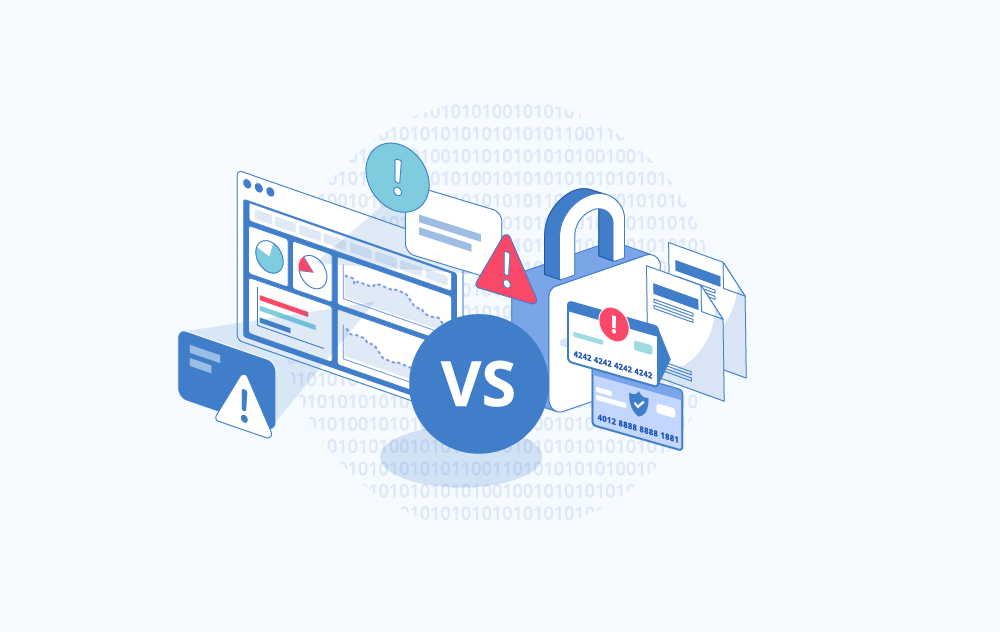
A Data Security Platform (DSP) and Data Security Posture Management (DSPM) solve different problems. DSPM tells you where your sensitive data sits and flags the risks around it. A DSP takes that same data and renders it useless to anyone who steals it.
DSPM watches the doors. A DSP empties the vault and replaces the contents with decoys. IBM pegged the global average data breach cost at $4.44 million in 2025; in the United States, that figure climbed to $10.22 million. The question for security buyers is whether monitoring sensitive data is enough or whether you need to neutralize it.
A Data Security Platform brings data discovery, classification, and protection under one roof. It finds sensitive data across your environment, labels it (PCI, PII, PHI), and applies enforcement — tokenization, masking, access controls — through a single policy framework.
Most data security tools stop at discovery. They tell you where your credit card numbers are.
A data security platform tokenizes those numbers the moment they are discovered, without waiting for a security analyst to triage an alert and open a ticket. Gartner's Market Guide for Data Security Platforms identifies this convergence — discovery, classification, and active protection in a single tool — as the direction the market is heading.
Tokenization replaces sensitive values with tokens — random strings that carry no mathematical relationship to the original data. There is no key. There is no algorithm. If someone steals a tokenized database, they get gibberish.
This is where tokenization parts company with encryption. Encrypted data can be reversed if you have the key. Tokenized data cannot be reversed at all, because the token was never derived from the original value — it was randomly generated and mapped in a separate, secured vault.
Tokenization is quantum-resistant by design. Encryption algorithms (AES-256, RSA) will eventually fall to quantum computing.
Adversaries are already hoarding encrypted data to decrypt later. Tokenization removes that risk entirely, because there is nothing to decrypt — not now, not in ten years, not ever.
There is a compliance dimension to this. The PCI Security Standards Council recognizes tokenization as a way to shrink the Cardholder Data Environment (CDE). Replace cardholder data with tokens, and those systems drop out of PCI DSS scope. That can shift an organization from the full SAQ D assessment to the lighter SAQ A.
A data security platform implements Zero Trust at the data layer.
All sensitive data is tokenized or masked by default. Viewing the original values requires explicit authorization — verified against user role, device posture, location, and business justification. That is the NIST SP 800-207 Zero Trust principle — never trust, always verify — applied to the data itself.
Most Zero Trust implementations miss the data layer. They verify identities, segment networks, monitor endpoints — and leave the data itself sitting in plaintext. One compromised credential, and the entire database is exposed.
A data security platform closes that gap. Even an authenticated insider with valid credentials sees tokenized data unless a policy explicitly authorizes de-tokenization for a specific purpose.
DSPM scans your cloud, SaaS, and on-premises environments to find sensitive data, classify it, and flag risks — i.e., overexposed storage buckets, misconfigured access controls, orphaned data in locations nobody is monitoring. It builds a continuous inventory of where your sensitive data lives, who can reach it, and how it is moving.
This is useful work. Gartner and Forrester have both validated DSPM as a category.
Vendors like Cyera, BigID, Varonis, and Wiz have built capable platforms around it. For organizations that genuinely do not know where their sensitive data resides — and many do not — DSPM is a necessary first step.
The problem is what happens after discovery. DSPM tools generate alerts. They surface risks and feed remediation workflows. But they do not block access, mask values, or tokenize data. Enforcement depends on a separate tool — a DLP system, an IAM policy, or a data security platform.
That gap between discovering exposed data and fixing it — i.e., the detection-to-remediation window — is where breaches happen.
When DSPM generates hundreds of alerts a day across dozens of cloud services, security teams face a triage problem. Without automated enforcement, you are managing a queue, not reducing risk.
DSPM is increasingly being applied to AI governance — i.e., discovering sensitive data that flows into training datasets, fine-tuning pipelines, and prompt contexts.
IBM's 2025 breach report found that 97% of organizations with AI-related breaches lacked proper access controls. Microsoft Purview DSPM for AI is one notable implementation.
Same problem as before. DSPM can tell you that customer PII is being fed into an LLM training pipeline. It cannot stop it. That requires tokenization before the data enters the pipeline — a DSP function.
The table below captures the core differences. They produce different breach outcomes, different compliance postures, and different operational loads for security teams.
DSPM bets on prevention: see every risk, respond fast enough, and you can stop breaches before they cause damage. This is an outside-in model — build the walls higher.
A data security platform bets on resilience: breaches will happen, so make the data worthless when they do. This is an inside-out model.
The economics favour resilience. Every dollar spent on prevention is wasted the moment a single attack succeeds. Every dollar spent on tokenization provides a permanent floor — even in the worst-case scenario, the stolen data is useless. The average breach lifecycle is still 241 days. That is 241 days of exposure that DSPM can flag but cannot fix.
DSPM documents your posture for auditors. It shows where sensitive data lives, who has access, and what controls exist. Useful for audit prep — but it does not change what falls under compliance scope.
Tokenization changes the equation. Replace cardholder data with tokens and those systems exit PCI DSS scope. Replace PHI with de-identified tokens and HIPAA exposure shrinks.
The compliance cost savings are not theoretical — they are measurable in fewer systems to audit, fewer controls to maintain, and fewer personnel required to manage the compliance programme.
Four abbreviations keep appearing in data security buying cycles: DSP, DSPM, DLP, and CSPM. They overlap in places but differ in one critical respect — only one of them protects the data itself.
DLP monitors data movement and blocks unauthorized transfers. DSPM monitors data at rest and flags posture gaps. CSPM evaluates cloud infrastructure configuration.
All three monitor or restrict, i.e., none of them transform the data in a way an attacker cannot use it. A data security platform does.
The competitive field is thinning. Six of the top ten Google results for "DSP vs DSPM" in early 2025 now return 404 errors — including pages from Velotix, ALTR, Sotero, and Thales. Satori was acquired by Commvault. The DSPM vendors that remain — Cyera, BigID, Varonis — are adding enforcement features, i.e., evolving into data security platforms.
The Gartner Market Guide for Data Security Platforms reflects this convergence. Standalone DSPM — visibility without enforcement — is being absorbed into broader platforms.
Organizations evaluating DSPM tools should ask a direct question: does this product enforce protection, or does it generate alerts for someone else to act on?
IBM's 2025 Cost of a Data Breach Report found that organizations using AI and automation in their security operations saved an average of $1.9 million per breach.
Faster detection helps. But detection is not the same as neutralization. The average breach lifecycle remains 241 days. A DSPM can flag a breach at day one. Unless the data was already tokenized, the damage is done.
The cost argument goes beyond incident response.
Tokenization reduces the number of systems under PCI DSS scope, thereby lowering audit costs, the controls that must be maintained, and the compliance personnel required. For large enterprises, that is a seven-figure annual saving.
Quantum computing will eventually break current encryption standards. NIST is already publishing post-quantum cryptographic algorithms to replace vulnerable ones.
Tokenization sidesteps the problem entirely. There is no algorithm to break, no key to factor, no ciphertext to harvest. Organizations holding financial records, healthcare data, or government files with long retention requirements should already be planning for this.
Evaluate a data security platform on three things.
First, legacy and mainframe support. Most enterprises run critical workloads on mainframes, AS/400 systems, and legacy ERPs. A DSP that only supports cloud-native environments leaves the systems holding your most sensitive data unprotected.
Second, real-time enforcement without code changes. Gateway-based deployment models intercept and tokenize data in-line — no application rewrites, no API integrations, no connector sprawl. The difference between a months-long integration project and a deployment measured in weeks.
Third, an integrated discovery-to-protection pipeline. The DSP should discover sensitive data, classify it, and protect it in a single automated workflow. No manual handoff. No gap between finding the exposure and fixing it.
DataStealth combines data discovery, classification, and real-time tokenization in a single platform — closing the gap between DSPM visibility and DSP enforcement:

Bilal is the Content Strategist at DataStealth. He's a recognized defence and security analyst who's researching the growing importance of cybersecurity and data protection in enterprise-sized organizations.