From personal details and payment card data to health records and government IDs, DataStealth ensures sensitive data is protected wherever it lives or moves.
schedule a demoWhether it's patient health data, customer payment info, or government IDs, DataStealth replaces sensitive values with secure substitutes – i.e., tokenization, masking, or encryption – so applications keep working, but risk disappears.
First Name, Last Name
Address, Zip, Postal Code
Email, Phone, Area Code
Payment Card Number
Personal Account Number
Cardholder Name
CVV
Health Card
Demographic Info (Name, Address, DOB, etc.)
Medical History (Illnesses, Treatments, Results)
Insurance Information (Policy, Claims)
Biometric Data (Fingerprint, Retina, Voice)
Electronic Health Records (EHR)
DICOM
Health CardBank Account
Transit Number
Swift Number
Credit Score
Passport
Driver’s License
Social Security Number (SSN)
Social Insurance Number (SIN)
IP Address / MAC Address
GUID
User ID
Password
Date / Time

DataStealth protects every major category of regulated and sensitive information – PII (names, addresses, emails, phone numbers, Social Security Numbers), PHI (health cards, medical history, insurance records, biometric data, EHR, DICOM images), and PCI data (payment card numbers, cardholder names, CVVs, Personal Account Numbers).
Beyond the standard categories, DataStealth also covers banking identifiers – e.g., bank account numbers, transit numbers, SWIFT codes, and credit scores – as well as government-issued IDs like passports, driver's licences, and Social Insurance Numbers.
Technical identifiers are included too – IP addresses, MAC addresses, GUIDs, user IDs, passwords, and timestamps. The data classification engine identifies each data type automatically through pattern matching, contextual analysis, and named-entity recognition, and the platform applies the appropriate protection policy per element.
DataStealth applies de-identification at the field level using three methods – each configurable per data element based on your compliance requirements and operational needs.
Tokenization replaces sensitive values with format-preserving surrogate tokens – i.e., a 16-digit PAN becomes another 16-digit value that passes Luhn checks but contains no exploitable data. Masking obfuscates values with redacted characters, partial reveals (e.g., "****1234"), or realistic pseudonyms for test and QA environments. Encryption transforms data into ciphertext using AES-GCM or format-preserving algorithms.
The method you choose depends on the use case. Tokenization is ideal for PCI scope reduction. Masking suits role-based access and dynamic visibility controls. Encryption provides foundational protection for data at rest and in transit.
Under PCI DSS, any system that stores, processes, or transmits cardholder data – i.e., PANs, cardholder names, CVVs, or expiration dates – falls within audit scope. That means every server, database, application, and network segment touching that data is subject to assessment.
Tokenization removes systems from scope by replacing cardholder data with tokens before it reaches downstream applications. Since tokens are not classified as cardholder data under PCI DSS, the systems that store and process them are excluded from the Cardholder Data Environment (CDE).
DataStealth applies tokenization at the protocol layer – inline, before data reaches your databases or SaaS applications – so scope reduction happens automatically. For financial services and retail organizations processing millions of transactions, this translates directly into fewer systems to assess, lower compliance costs, and faster audit cycles.
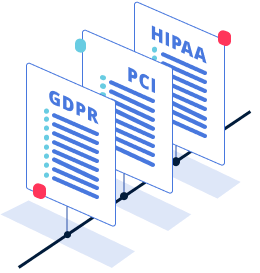
Each data type is governed by different regulations, and the penalties, scope, and protection requirements differ significantly.
PII compliance – governed by GDPR, CCPA/CPRA, PIPEDA, and similar privacy laws – requires that organizations document what personal data they hold, where it resides, and who can access it. Enforcement focuses on data subject rights – i.e., right to access, right to erasure, and DSARs.
PHI compliance – governed by HIPAA in the US – requires covered entities and business associates to implement administrative, physical, and technical safeguards for protected health information. HIPAA data masking and encryption are common implementation paths.
PCI compliance – governed by PCI DSS – mandates specific controls for cardholder data, including encryption, access restrictions, and vulnerability management. Tokenization is the most effective path to scope reduction.
DataStealth's data discovery engine identifies all three data types across your environment, the classification engine labels them by sensitivity and regulation, and the protection layer applies the appropriate method – all from a single platform.