
Protecting sensitive data across hybrid environments, cloud workloads, and legacy systems is no longer optional; rather, it's a compliance requirement.
A data protection platform gives regulated industries a unified solution to discover, classify, mask, encrypt, and control sensitive data – without rewriting applications.
This guide explains what a data protection platform is, when you need one, and how to choose the right solution for your environment.
Key Takeaways
Data protection platforms help regulated industries:
- Reduce compliance scope through tokenization.
- Secure non-production data with masking.
- Minimize breach impact by removing sensitive data from systems.
- Address data sprawl across cloud, SaaS, and legacy environments.
- Meet regulatory requirements for PCI DSS, HIPAA, GDPR, and SOC 2.
The right platform depends on your environment complexity, performance requirements, and compliance needs. Agentless, network-layer solutions like DataStealth offer the fastest path to protection without application changes or integration overhead.
What is a Data Protection Platform?
A data protection platform is enterprise software that secures sensitive data across databases, applications, cloud environments, and SaaS tools.
It combines multiple security functions into a single solution: data discovery, classification, tokenization, encryption, masking, and access control.
Key characteristics:
- Discovers and classifies PII, PHI, and PCI data automatically.
- Protects data at rest, in transit, and in use.
- Supports on-premises, cloud, and hybrid deployments.
- Provides audit trails for compliance reporting.
- Reduces the attack surface by removing or masking sensitive data.
A data protection platform is different from a DSPM tool. DSPM tools find sensitive data. Data protection platforms neutralize it.
Why Data Protection Platforms Matter for Regulated Industries
Regulated industries face strict data protection requirements under PCI DSS, HIPAA, GDPR, SOC 2, and CCPA. Non-compliance leads to fines, lawsuits, and reputational damage.
Three challenges drive adoption:
1. Data Sprawl
Sensitive data flows into Salesforce, Jira, Snowflake, Google Drive, and dozens of other systems. Without centralized protection, managing this data becomes manual, error-prone, and unscalable.
2. Non-Production Risk
Development and testing environments often contain live production data. This exposes PII to developers, contractors, and third parties who don't need access to real customer information.
3. Breach Impact
When attackers breach a system, the damage depends on what they find. If sensitive data is tokenized or masked, stolen data is worthless. Traditional encryption alone doesn't provide this protection because encrypted data with a compromised key is fully exposed.
Core Capabilities of a Data Protection Platform
Modern data protection platforms include these essential functions:
Data Discovery and Classification
The platform scans databases, file systems, cloud storage, and applications to locate sensitive data. It then classifies data by type (PII, PCI, PHI), sensitivity level, and regulatory requirement.
Discovery happens continuously. New data is classified as it enters the environment.
Data Masking
Data masking hides sensitive values for non-production use. Masked data looks realistic but contains no real customer information. Developers can test applications without accessing actual PII.
Example:
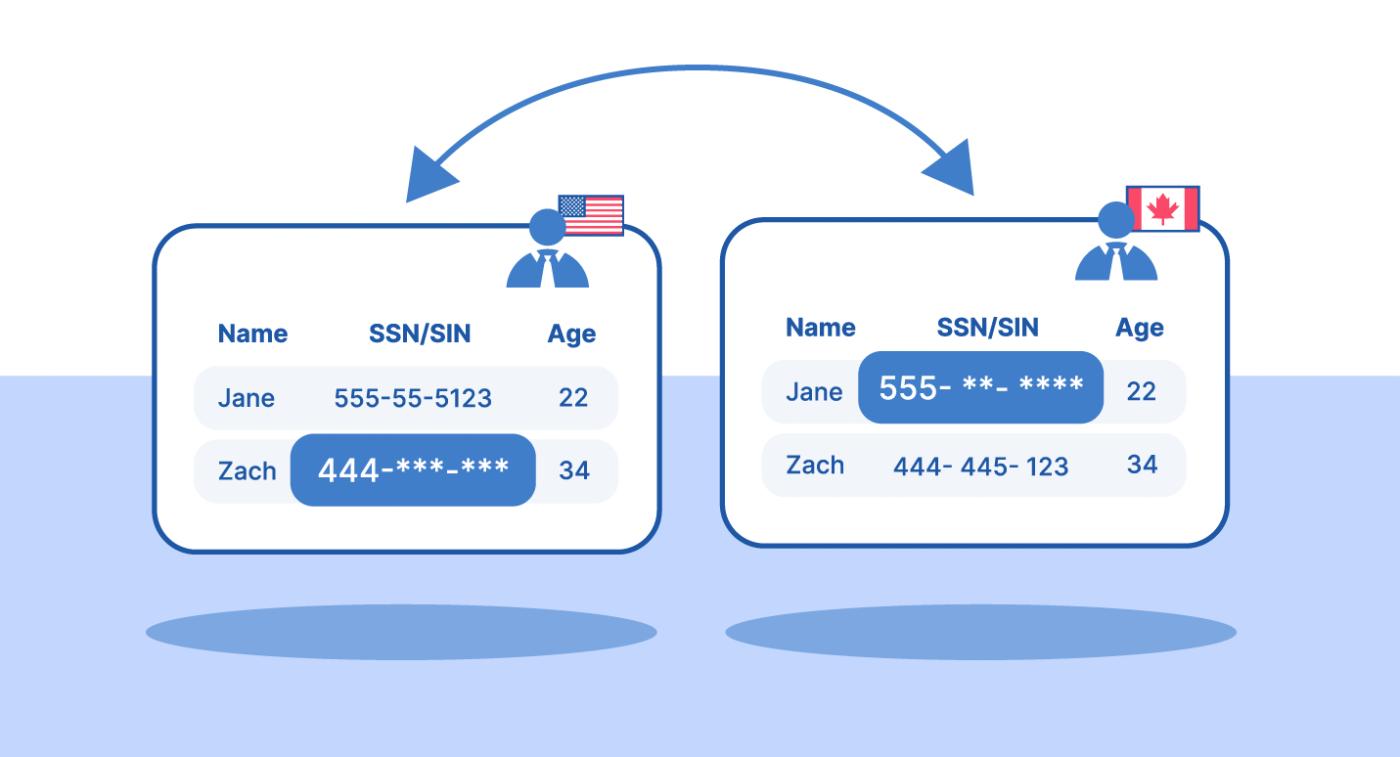
Masking is often irreversible. It's ideal for test environments, analytics, and training systems.
Data Tokenization
Tokenization replaces sensitive data with a non-sensitive placeholder. The original data is stored in a secure vault. The token has no mathematical relationship to the original value.
Example:
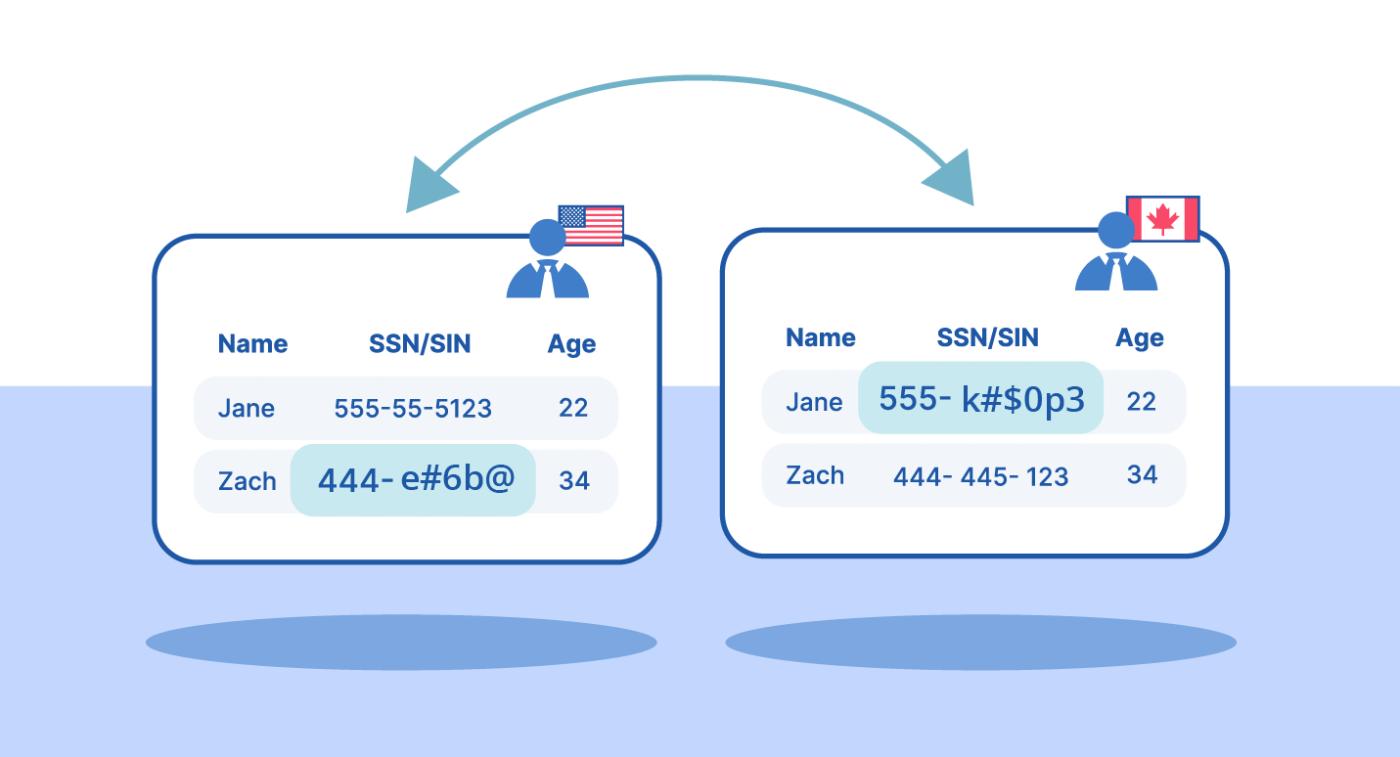
If attackers breach the database, they get tokens – not usable data.
Tokenization vs encryption vs masking: each protects data differently. Tokenization removes data from systems. Encryption protects data in place. Masking hides data for specific use cases.
Data Encryption
Encryption transforms data using a cryptographic algorithm. It protects data at rest (stored on disk) and in transit (moving across networks).
Key Characteristics:
- Reversible with the correct decryption key.
- Widely standardized (AES-256, TLS 1.3).
- Required for compliance baselines.
- Does not reduce compliance scope.
Encryption alone doesn't stop insider threats or misuse by authorized users.
Format-Preserving Encryption
FPE encrypts data while maintaining its original format and length. A 16-digit credit card number remains a 16-digit string after encryption. This allows protection without application changes.
FPE is ideal when:
- Legacy systems require specific data formats.
- Re-identification is rarely needed.
- Performance is critical.
Access Control
Granular access controls limit who can view unmasked data. This includes role-based access control (RBAC), attribute-based access control (ABAC), and least privilege enforcement.
Advanced platforms add anomaly detection. Machine learning identifies unusual data access patterns that could indicate a breach or insider threat.
Auditing and Reporting
The platform logs all data access attempts, policy enforcement actions, and security events. These logs generate reports for compliance audits and incident response.
Format Preserving Encryption vs. Tokenization: Side-by-Side
Choosing between FPE and tokenization depends on your use case.
When to use FPE: Legacy system compatibility, high-throughput scenarios, one-way data flows.
When to use tokenization: PCI DSS scope reduction, cross-system consistency, complete sensitive data removal.
Key Considerations When Choosing a Data Protection Platform
Technical architects evaluating data protection platforms should assess these factors:
Scalability and Performance
Processing petabyte-scale databases with billions of rows requires horizontal scalability. The platform must process data concurrently without introducing unacceptable latency.
Ask vendors for specific latency numbers for FPE and tokenization operations under peak load.
Deployment Flexibility
The platform should support your infrastructure:
- On-premises: Data center, bare metal, VMs, containers, Kubernetes.
- Cloud-native: AWS, Azure, GCP with native service integration.
- Hybrid: Consistent protection across cloud and on-premises systems.
Integration Ecosystem
Modern enterprises use hundreds of applications. The platform should integrate with:
- Databases (Oracle, PostgreSQL, MySQL, SQL Server)
- Cloud data warehouses (Snowflake, Redshift, BigQuery)
- SaaS applications (Salesforce, Jira, ServiceNow)
- Messaging systems (Kafka, RabbitMQ)
- File storage (S3, CIFS, NFS)
- Legacy systems (mainframes, AS/400)
Platforms with a network-layer architecture can intercept and protect data in transit without requiring API integrations for each system.
Referential Integrity
In sharded or distributed databases, the same sensitive value must resolve to the same token across all systems. Deterministic tokenization guarantees this consistency.
Without referential integrity, joins, deduplication, and analytics break.
Operational Burden
Evaluate the resources required to operate the platform:
- Does it require agents on every server?
- Does it need custom code for each integration?
- What skill sets does your team need?
Platforms with no-code, agentless architectures minimize operational overhead.
Compliance Support
The platform should directly support your compliance requirements:
- Pre-built reporting templates for PCI DSS, HIPAA, SOC 2.
- Demonstrable controls for PII, PHI, and PCI data.
- Audit-ready evidence collection.
When Should You Use a Data Protection Platform?
Use a data protection platform when you need to:
- Reduce compliance scope. Tokenization removes sensitive data from PCI DSS and HIPAA scope.
- Secure non-production environments. Mask production data for development, testing, and analytics.
- Protect data in SaaS applications. Prevent sensitive data from landing "in the clear" in Salesforce, Jira, or Slack.
- Address data sprawl. Centralize protection across hundreds of applications and databases.
- Minimize breach impact. Ensure stolen data has no value to attackers.
- Meet regulatory requirements. Demonstrate compliance with PCI DSS, HIPAA, GDPR, SOC 2, and CCPA.
Data Protection Platform vs DSPM: What's the Difference?
DSPM (Data Security Posture Management) tools and data protection platforms solve different problems.
DSPM tools tell you where sensitive data exists and alert you to risks. Data protection platforms neutralize that data so breaches don't matter.
Many organizations use both. DSPM provides visibility. Data protection platforms provide control.
Top Data Protection Platforms
Several platforms address enterprise data protection requirements. Here's how they compare:
DataStealth
DataStealth uses an agentless, network-layer architecture. It intercepts data in transit and protects it without agents, code changes, or API integrations.
Key strengths:
- No-code, no-agents, no-collectors deployment.
- Universal compatibility (mainframes, cloud, SaaS).
- Horizontal scalability for petabyte data volumes.
- Deterministic tokenization and FPE.
- Protects non-production environments without application changes.
DataStealth is ideal for complex environments with legacy systems, SaaS data sprawl, and high-throughput requirements.
Thales CipherTrust
Thales CipherTrust Manager provides centralized key management and encryption across hybrid environments. It offers database encryption, application encryption, and tokenization with strong HSM integration.
Key strengths:
- Comprehensive encryption capabilities.
- Hardware security module (HSM) support.
- Data discovery and classification.
- Strong key management.
Varonis
Varonis specializes in data security posture management for unstructured data. It identifies sensitive data in file shares, SharePoint, and cloud storage while monitoring access patterns.
Key strengths:
- Unstructured data focus.
- Behavioral analytics and anomaly detection.
- Access control recommendations.
- Automated remediation.
Baffle
Baffle provides database and application encryption without code changes. It focuses on protecting data at rest, in memory, and in use within databases.
Key strengths:
- No-code database protection.
- Encryption, tokenization, and masking.
- Minimal performance impact.
- Cloud data store support.
Cyera
Cyera is an AI-powered DSPM platform. It discovers and classifies sensitive data across SaaS, IaaS, and PaaS environments with automated risk assessment.
Key strengths:
- Agentless deployment.
- AI-powered classification.
- Cross-cloud visibility.
- Risk prioritization.
Sentra
Sentra provides DSPM across cloud and on-premises environments. It focuses on sensitive data discovery, classification, and movement detection.
Key strengths:
- Agentless discovery.
- Data movement monitoring.
- Multi-cloud support.
- Compliance tracking.
How DataStealth Approaches Data Protection
DataStealth takes a different approach to data protection. Instead of requiring agents, collectors, or API integrations, it operates at the network layer.
How It Works
DataStealth sits inline and inspects network traffic at the packet level. It extracts sensitive data and replaces it with tokens or masked values in real-time. The original data never reaches the destination system.
Deployment is simple: A DNS change routes traffic through DataStealth. No application modifications. No agents to install.
Key Capabilities
- Data discovery: Automatically identifies PII, PHI, and PCI data in transit.
- Data classification: Categorizes data by type and sensitivity.
- Data protection: Tokenization, FPE, and masking in real-time.
- Deterministic tokenization: Same input produces same token for referential integrity.
- Universal compatibility: Mainframes, cloud, SaaS, databases, file shares.
Use Cases
- Protecting non-production environments: Mask production data before it reaches dev/test systems.
- Securing SaaS applications: Prevent PII from landing in Salesforce, Jira, or Slack.
- Cross-border data transfers: Tokenize data before it leaves regional boundaries.
- Protecting data in transit and at rest: Consistent protection across the data lifecycle.
FAQ
This section answers common questions about data protection platforms and how they secure sensitive data across enterprise environments.
1. What is a data protection platform?
A data protection platform is enterprise software that secures sensitive data across databases, applications, cloud environments, and SaaS tools. It combines data discovery, classification, tokenization, encryption, masking, and access control into a single solution.
2. Why are data protection platforms essential for regulated industries?
Regulated industries must comply with PCI DSS, HIPAA, GDPR, and SOC 2. Data protection platforms provide the technical controls and audit trails required to demonstrate compliance while reducing breach risk.
3. What is the difference between tokenization and encryption?
Tokenization replaces sensitive data with a non-sensitive token stored in a secure vault. Encryption transforms data using a cryptographic algorithm that can be reversed with the correct key. Tokenization removes data from compliance scope; encryption does not.
4. What is Format Preserving Encryption (FPE)?
Format Preserving Encryption encrypts data while maintaining its original format and length. A 16-digit credit card number remains a 16-digit string after encryption. FPE enables protection without application changes.
5. How does DataStealth protect data without agents?
DataStealth operates at the network layer, intercepting data in transit and replacing sensitive values with tokens or masked data in real-time. Deployment requires only a DNS change—no agents, code changes, or API integrations.
6. Can data protection platforms secure non-production environments?
Yes. Platforms use masking and tokenization to anonymize production data for development, testing, and analytics. This eliminates PII exposure in non-production systems.
7. What is referential integrity in tokenization?
Referential integrity means the same sensitive value produces the same token across all systems. Deterministic tokenization guarantees this consistency, enabling joins and analytics across distributed databases.
8. How do data protection platforms differ from DSPM tools?
DSPM tools discover and monitor sensitive data. Data protection platforms neutralize sensitive data through tokenization, encryption, and masking. DSPM provides visibility; data protection platforms provide control.

DataStealth is a data security platform (DSP) that allows organizations to discover, classify, and protect their most sensitive data and documents, ensuring that sensitive data and documents are secure and meet applicable regulatory requirements.
Connect on LinkedIn →